
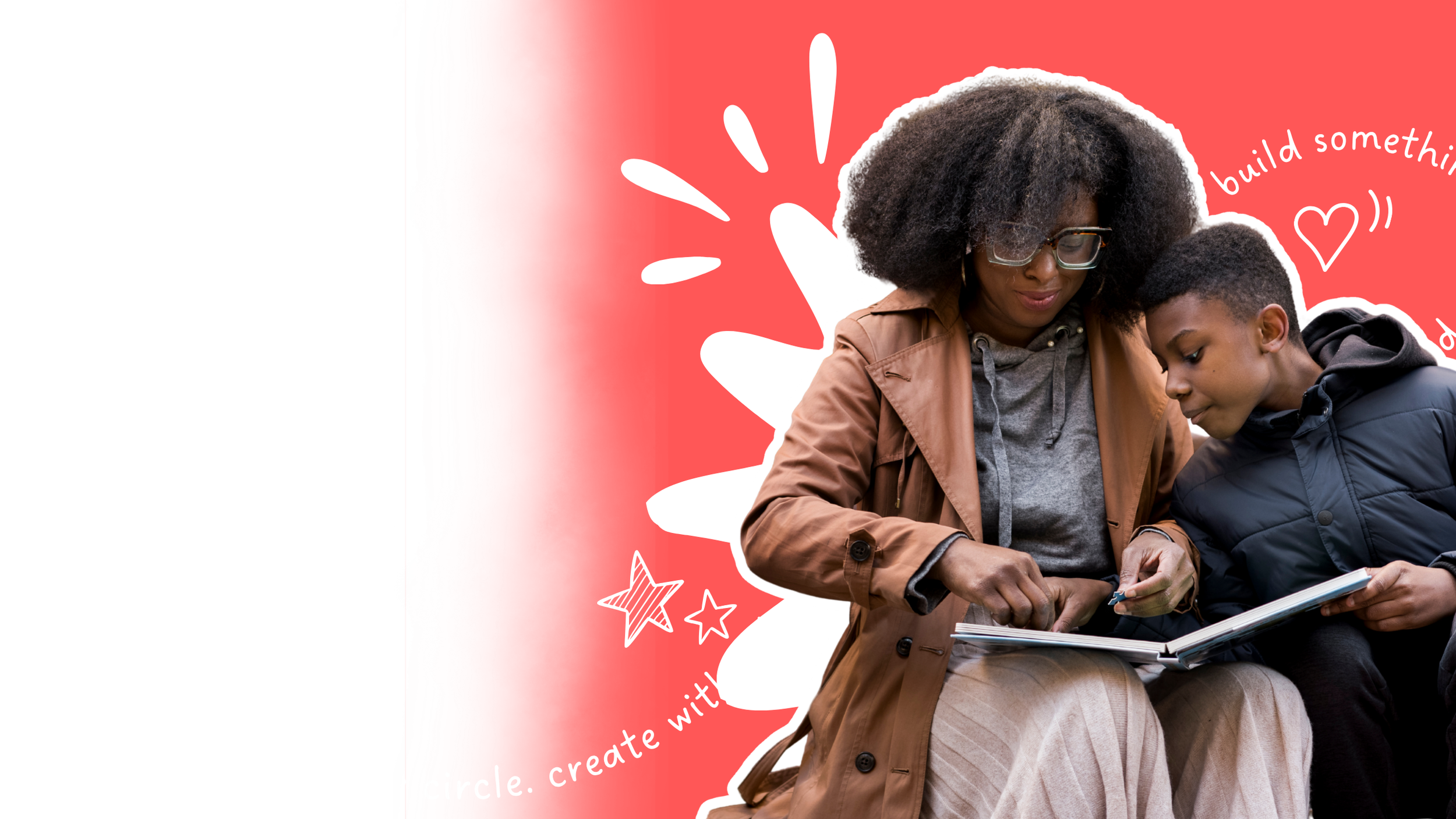
Education Without Erasure
Education without erasure means no part of a student’s identity is left at the door; their identity, heritage and lived experiences are the very pieces that complete our community. In this space, education serves to profoundly affirm who you are today while guiding you toward who you will become tomorrow. We empower our students to use their unique voices to engage with the world, ensuring that academic mastery always goes hand-in-hand with their full personhood.

At Mosaic, We…
-
We believe history must be truthful and must be inclusive. Our students explore multiple perspectives and rich texts to gain a deeper, more complete understanding of the world and each other.
-
As students move from elementary to high school, they gently transition from guided, family-supported learning into confident, independent thinkers who are fully prepared for life after graduation.
-
We are dedicated to building a welcoming space where everyone belongs. We teach students to understand different viewpoints, resolve conflicts peacefully, and grow into compassionate, civic-minded leaders.
-
We look beyond standard multiple-choice tests. We measure your child’s true progress through meaningful projects and portfolios, while still ensuring they build a highly competitive transcript for college admissions.
-
We believe that student wellness is foundational to learning, growth, and whole-person development. A flourishing student is one who is seen, supported, and strengthened in spirit, mind, and body. Wellness and learning work in tandem as cognitive and physical function, mental and emotional health, and social development all improve learning outcomes.
-
Our educators don't just lecture from the front of the room. They act as supportive mentors who ask the right questions, lead engaging discussions, and empower students to discover answers for themselves.

Power. Love. Sound Mind.
Powerful Learning Requires a Sound Mind
A student cannot reach for intellectual greatness if they are bound by dysregulation or fear. Powerful Learning happens when we prioritize holistic wellness as the prerequisite for academic rigor. From our youngest Kindergarteners using tangible tools to transition from separation anxiety to confident engagement, to older students engaging in transformative civil discourse, we actively cultivate psychological and emotional security. A Sound Mind allows learners to replace fear with intentionality, ensuring they are fully present to grapple with complex ideas.
Powerful Learning is Sustained by Love
We reject educational models built on shame, isolation, or artificial competition. Powerful Learning happens when the learning commons becomes a place of profound relational safety and mutual affirmation, upholding the Imago Dei in every individual. Whether it is 7th-grade girls exploring their shared developmental journeys in Thrive 360 groups, or a classroom celebrating a peer’s advanced academic achievements rather than isolating them, Love is the mechanism that widens our circle. When students feel deeply seen and secure, learning becomes a joyful act of community building.
Powerful Learning Activates Power and Agency
We do not view our students as passive recipients of a monolithic track; we view them as thought leaders and architects of their own futures. Powerful learning looks like an agile environment where teachers use their professional agency to bridge a 3rd-grade twice-exceptional student into advanced concepts without the hindrance of institutional red tape. It looks like 12th-grade students analyzing workforce patterns to map unrestricted, fulfilling post-graduate paths on their own terms. Power is realized when students are trusted with the exact tools they need to build a life lived well.
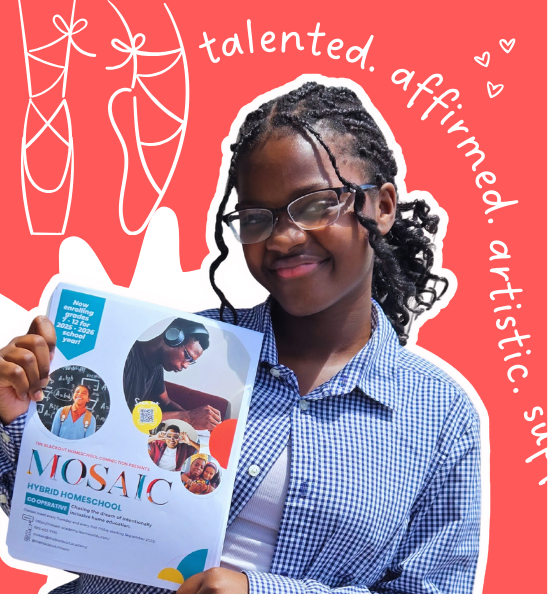
Beyond the Traditional Model
Still have questions? Take a look at the FAQ or reach out anytime. If you’re feeling ready, go ahead and apply.
-
Growth! Instead of high-stakes exams, we utilize MAP Growth assessment four times an academic year (a baseline, plus Fall, Winter, and Spring check-ins). Our goal is Continuous Ascent. We do not focus on one-size-fits-all grade-level requirements. Instead, we measure and celebrate your individual child's unique growth curve from the exact point they started.
-
We believe academic progress is a communal celebration of your child's growth, not just a private transaction in a grade book. We have moved beyond traditional letter grades (A-F), instead utilizing a competency-based "Mastery Scale" (Emerging, Developing, Mastery, Excellence), and evaluate your child across three pillars:
The Portfolio (50%): Qualitative evidence proving she is learning the "Mosaic Way" through artifacts, reflections, and capstone presentations.Academic Growth (25%): Quantitative rigor proving she is maintaining operational momentum on the NWEA MAP Growth RIT scale.
Character Vitality (25%): Relational alignment measuring her ability to lead with Power, Love, and a Sound Mind (The Thrive 360 Rubric).
-
As a newly established educational cooperative, we are currently in the foundational stages of the accreditation process and look forward to an update in 2026!
-
Our cooperative model is designed to gradually shift responsibility from the parent to the student as they mature. Below is the expected weekly breakdown of active parental involvement for home learning days.
Elementary School (Grades K–4): The Foundational Discovery Model
The Parent's Role: Primary Co-Educator
Active Time Investment: 8–12 hours a week
At this stage, parents are actively guiding phonics, math foundations, and establishing daily "Sound Mind" rhythms. While direct, active instruction takes about 8–12 hours a week, students in this phase do not yet have the executive function to self-regulate and still require a parent present for general supervision and transition support throughout their at-home learning days.
Middle School (Grades 5–8): The Co-Teacher Model
The Parent's Role: Direct Partner & Executive Function Coach
Active Time Investment: 6–8 hours a week
As students transition toward independence, the parent’s role shifts from direct instruction to shepherding their organization and accountability. This active time is spent ensuring home preparation is robust, reviewing complex concepts, and guaranteeing that campus time remains highly effective.
High School (Grades 9–12): The Independent Learner Model
The Parent's Role: Supporter, Guide & Project Manager
Active Time Investment: 2–4 hours a week
High school students are expected to take full ownership of their intellectual preparation. The parent steps back into an advisory role—reviewing long-term goals, discussing grades, and helping students analyze their paths to map fulfilling, unrestricted futures.
A Note on Pacing and Unique Learners: These time investments represent the average weekly requirement for active engagement. Students actively developing their executive functioning skills, or twice-exceptional (2e) learners, may require a higher initial time investment from the parent to successfully bridge the gap to independent learning.
-
We believe that mistakes and conflict are not just rule-breaking, but opportunities for discipleship, growth, and repairing relationships. We explicitly reject punitive, zero-tolerance models that rely on public shaming. Instead, our discipline structure is directly modeled after the redemptive process outlined by Jesus in Matthew 18:15-17. By pairing this biblical blueprint with a trauma-informed approach, we ensure that our students are held to a standard of excellence while remaining safe, supported, and deeply loved.
-
We select instructors who are both subject matter experts and deeply grounded in our foundational mandate of Power, Love, and a Sound Mind (2 Timothy 1:7). We do not just hire teachers; we hire culturally sustaining stewards who view the education of a child—spirit, mind, and body—as an act of worship.
Every Mosaic Instructor is vetted against four core pillars:
Verified Subject Matter Authority: Instructors must possess a post-secondary degree or at least three years of professional experience in their field, ensuring our operational rigor is never compromised.
Commitment to "Education Without Erasure": We hire educators who actively value and restore the diverse histories and identities of our students, ensuring every learner is known, named, nurtured, and loved.
Growth-Centric Pedagogy: Our teachers must view academic progress holistically. They are selected for their ability to use data (like MAP Growth) not to lower the bar, but to elevate the ceiling, demanding excellence while providing the exact support needed to reach it.
Restorative Leadership: We choose professionals who balance high relational support with fierce accountability. They must be equipped to de-escalate conflict through grace and direct counsel, prioritizing the restoration of the community over traditional, punitive discipline.
Because we reject the industrial model of passing students to strangers every year, our instructor pool is intimate and collaborative. This ensures your child builds deep, continuous trust with their teachers across their entire educational journey.
-
While Mosaic is firmly rooted in the Christian tradition and leads from a biblical worldview, we recognize that our God welcomes inquiry and discovery as a source of connection with His creation. To that end, we welcome families and students who are exploring these truths or seeking a community of "Power, Love, and a Sound Mind." Our doors are open to those who desire to participate in a culture of mutual respect, academic rigor, and restorative justice, provided they honor the spirit of the Commons and the mission of Education Without Erasure.