2026–2027 6th Grade Curriculum Roadmap: A Guide for Families
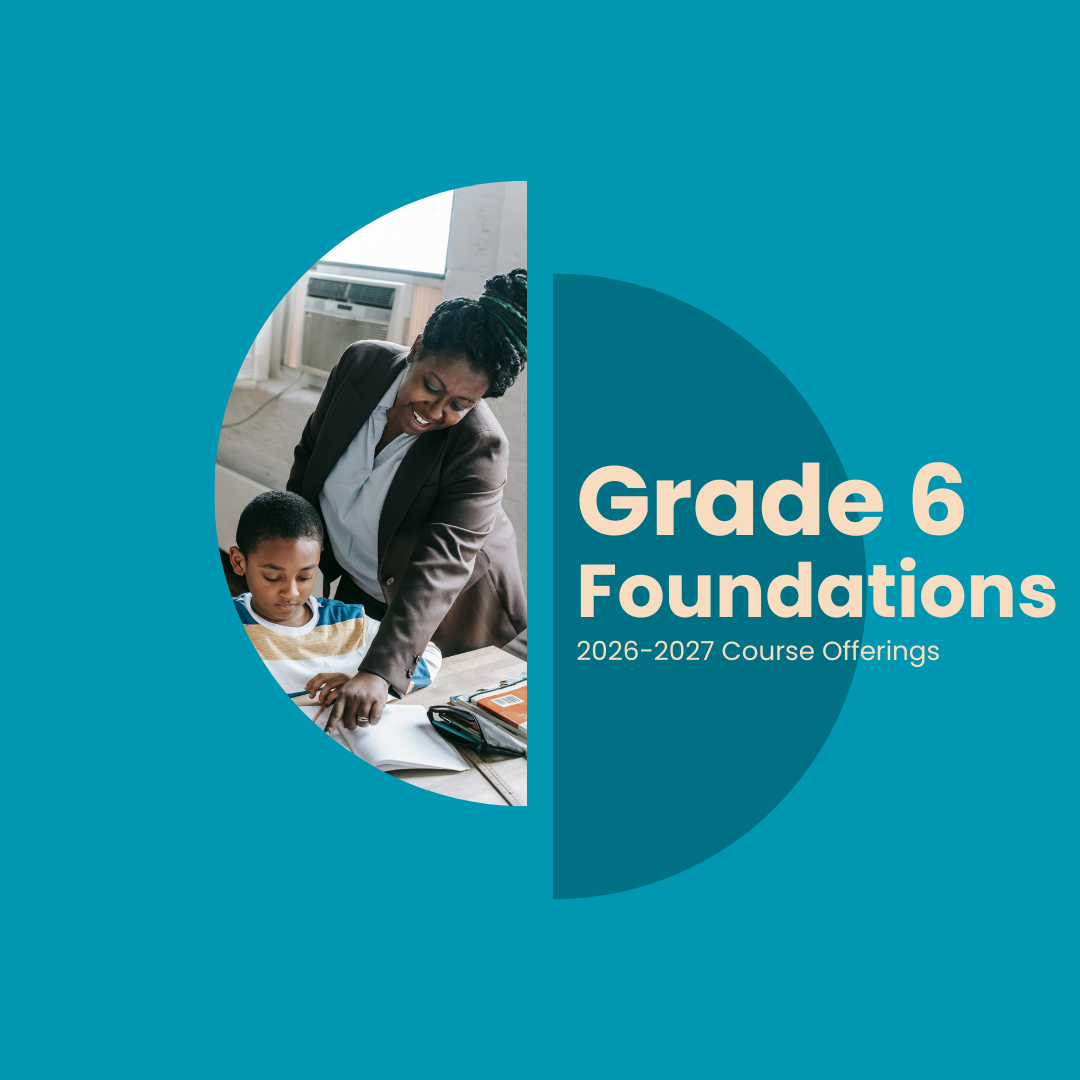
For the upcoming 2026–2027 academic year, our 6th-grade program is designed to bridge the transition from foundational learning to advanced critical thinking. Below is an overview of the core curriculum for our Tuesday and Thursday sessions to help you prepare for the year ahead.
6th grade is more than just a step up from elementary school…
“…it’s the bridge where foundational learning meets the spark of independent inquiry. At The Mosaic Collective, we aren’t just teaching subjects; we are equipping students to move from understanding the world to finding their unique voice within it.”
Krisette C, Founder
The 6th Grade Vision
Sixth grade at The Mosaic Collective is a pivotal bridge year. We move students from guided instruction toward independent inquiry, encouraging them to find their own voices while mastering the core academic skills necessary for secondary success.
-
Transitioning into sophisticated literary analysis and voice-driven writing.
Literary Analysis: Engaging with a diverse range of genres to identify themes, character development, and narrative structure.
Writing & Composition: Developing clear and coherent writing in various forms, including argumentative, informative, and narrative essays.
Grammar & Vocabulary: Focusing on the mechanics of language and the acquisition of academic vocabulary and Greek/Latin roots to enhance reading comprehension.
-
Building the bridge between concrete arithmetic and abstract algebraic thinking.
Ratios and Proportional Relationships: Understanding the concept of ratio and using ratio reasoning to solve problems.
The Number System: Deepening fluency with fractions and decimals; extending numbers to the system of rational numbers, including negative integers.
Expressions and Equations: Using variables to represent numbers and writing equations to solve real-world problems.
Geometry & Statistics: Solving problems involving area, surface area, and volume; developing an understanding of statistical variability and data distributions.
-
Exploring the "How" and "Why" of the natural world through hands-on exploration.
The Scientific Method: Mastering observation skills and the formal steps of scientific inquiry.
Lab Skills: Learning safe and effective laboratory techniques and equipment usage.
Core Disciplines: An introduction to Earth Science (geology/meteorology), Life Science (cells/ecosystems), and Physical Science (matter/energy).
Scientific Literacy: Building a robust scientific vocabulary to communicate complex findings.
-
Viewing the world through a global lens to understand the relationship between people and environments.
Geographical Skills: Mastering maps, timelines, and coordinates; identifying continents, countries, and major capitals.
Cultural Systems: Exploring global traditions, languages, and belief systems.
Comparative Systems: Analyzing different types of government and economic structures to see how various societies function.
Hello, World!